

Tourism now accounts for roughly 8 to 9 percent of global greenhouse gas emissions (source: Nature.com). That share has grown faster than the global economy itself over the past decade. Most travelers assume flights and long drives are the main culprit, and they’re right. But where you sleep once you arrive matters more than most people expect. Choosing lower-impact accommodation is one of the practical ways travelers can reduce their holiday footprint once they reach their destination. The effect is bigger than a single eco-friendly badge on a booking site. It touches energy use, water consumption, and waste for the entire length of a stay.
What Actually Shapes Your Holiday Footprint?

A holiday’s footprint comes from four main sources: transport, accommodation, food, and activities. Transport usually dominates the total, especially on international trips involving a flight. Accommodation, though, is the piece travelers have the most day-to-day control over once they’ve arrived.
Large resorts and conventional hotels can have significant energy and resource needs, particularly when they rely on extensive heating or cooling, frequent laundry services, large food operations, and other energy-intensive facilities. Smaller properties designed with the local climate and environment in mind may be able to avoid some of these demands. That difference can add up over a multi-night stay, even though accommodation is usually only one part of a trip’s overall footprint.
How Can Sustainable Accommodation Reduce Your Holiday Footprint?
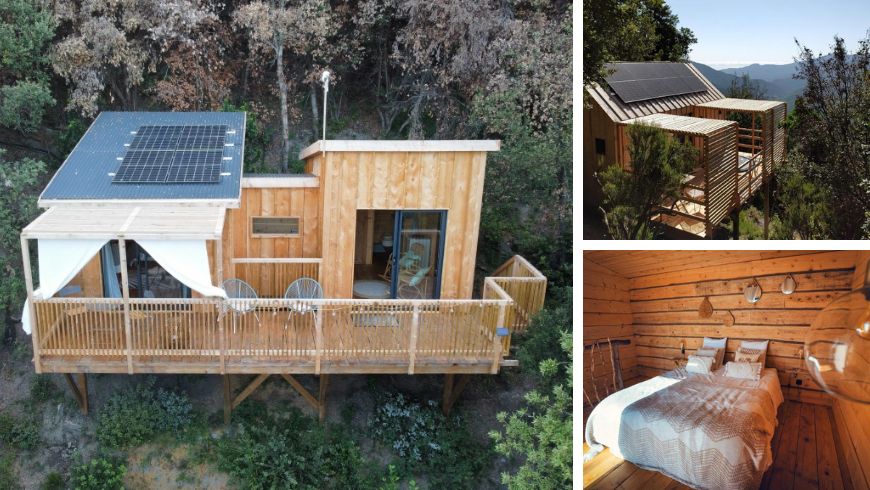
Accommodation designed in harmony with its local climate and natural surroundings can sometimes reduce energy and resource use. Passive design strategies such as natural shading, good insulation, appropriate window placement, and natural ventilation can reduce the need for mechanical heating and cooling.
For example, a well-insulated cabin shaded by trees needs far less artificial cooling than a glass-heavy resort under direct sun. A lodge positioned to catch cross-breezes rarely needs air conditioning at all. Even window placement and roof design, chosen with the local climate in mind, can cut a property’s cooling needs dramatically before any technology gets involved.
Other factors can make a much bigger difference than the setting itself: locally sourced food, renewable energy, water-saving systems, waste reduction, ecological cleaning products, and responsible purchasing policies can all contribute to a lower-impact stay.
Eco-friendly holiday homes in nature increasingly appeal to travelers for exactly this reason. They combine a lower footprint with the kind of quiet, restorative setting a conventional resort rarely offers.
What Do Off-Grid and Nature Stays Actually Change?

Off-grid stays change the footprint equation by removing dependence on a large power grid entirely. Solar panels, rainwater collection, and composting systems shift a property’s daily operations toward what the immediate environment can actually support.
That shift is more than symbolic. Off-grid homes surrounded by nature often use a fraction of the energy a comparable hotel room does. There’s no elevator, no central air system, and no commercial kitchen running around the clock. Even hot water often comes from a solar heater rather than a constantly running boiler. Staying somewhere built this way changes daily habits too. Guests tend to notice and match the property’s more deliberate use of water and electricity.
What Are the Small Choices That Add Up During a Nature-Based Stay?

Small choices during a nature-based stay add up because they multiply across every day of the trip rather than happening once. A few habits worth carrying into any eco-conscious stay:
- Reuse towels and linens instead of requesting daily changes
- Choose locally sourced meals over imported or packaged options
- Walk or cycle to nearby attractions when the option exists
- Turn off lights and climate control when a room sits empty
- Bring a reusable water bottle instead of relying on single-use plastic
None of these habits require sacrificing comfort. They simply align a guest’s daily behavior with the lower-impact setting they’ve already chosen to stay in, which is often easier at a nature-close property than at a large resort designed around convenience.
Why Do Short Getaways Carry a Bigger Footprint Than People Expect?

Short getaways can have a surprisingly high environmental footprint because the emissions generated by reaching the destination are concentrated over just a few days. A long-distance flight or car journey produces similar emissions whether you stay for three nights or a full week.
The hidden environmental cost of short getaways explores why taking many short trips can add significantly to a traveler’s annual footprint. For this reason, choosing destinations that are closer to home, traveling by train or other lower-carbon means of transport, and staying longer when possible can make a meaningful difference.
Once you arrive, choosing accommodation that uses energy and water efficiently, reduces waste, and follows other sustainable practices can further reduce the impact of your stay. The best approach is therefore not to choose between sustainable transport and sustainable accommodation, but to consider the whole journey—from how you get there to where you stay.
What Does the Data Say About Tourism’s Climate Impact?
Tourism’s climate impact is heavily weighted toward transport, but accommodation still represents a meaningful share of the total. Data from international travel bodies makes the scale of the problem clear, and it’s growing rather than shrinking.
UN Tourism’s research on tourism emissions shows transport-related tourism emissions are projected to keep growing through 2030 without significant intervention. Choosing lower-impact accommodation won’t offset transport emissions entirely. It does remove one of the few variables a traveler has full control over once the destination is already set.
Choosing Nature Doesn’t Mean Choosing Less

Choosing a low-impact accommodation won’t erase a holiday’s footprint entirely. It can reduce it, though, in ways that are easy to control once you know what to look for.
The accommodation choice is within reach of every traveler, regardless of how the trip was booked or how far it required flying. That’s part of what makes it such a practical starting point alongside other important choices, such as reducing travel distance and choosing lower-carbon transport.
Next time you plan a getaway, look beyond the setting and consider how the accommodation works with its environment. Choose a stay designed to use resources responsibly, and you can reduce the footprint of your stay without giving up the experience of being close to nature.
Cover image: photo via pexels.com

Author bio: Dana Whitfield is a freelance writer covering sustainable travel and everyday eco-conscious living. She occasionally contributes moving and relocation content for AZ Efficient Moving, and spends the rest of her time researching low-impact stays for her own next trip.


