
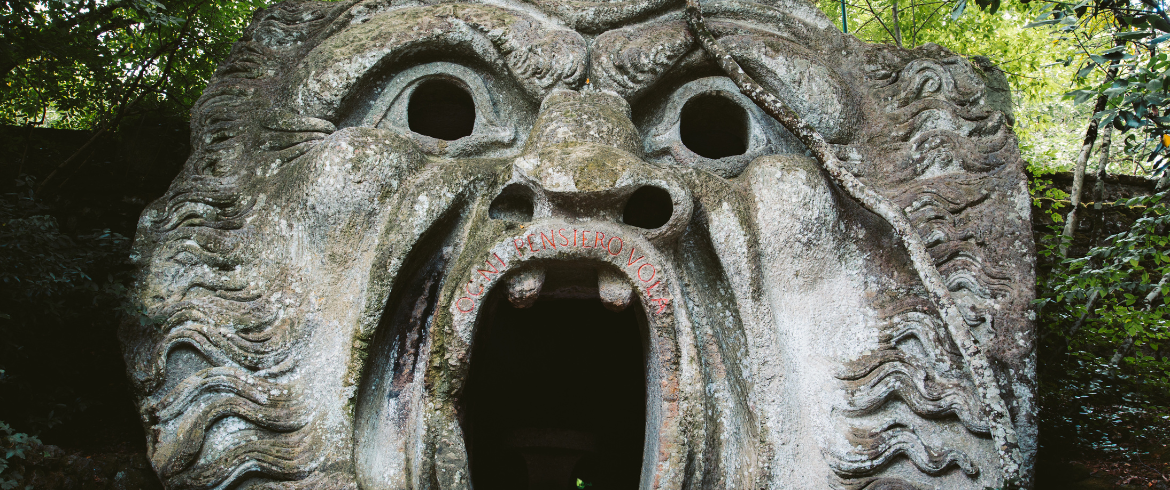
In Italy, there are places that seem to hold a story of their own. Hidden corners among woods, rocks and ancient villages, where the boundary between nature, art and imagination becomes almost impossible to distinguish. They are magical and secret places, and among them it is impossible not to mention Bomarzo, in the Tuscia area of northern Lazio.
Here, immersed in vegetation, lies one of Italy’s most enigmatic gardens: the Sacred Wood of Bomarzo, also known as the Park of Monsters. A place populated by enormous stone creatures, deities, fantastic animals and seemingly impossible architectural structures.
What is the Sacred Wood of Bomarzo?
The Sacred Wood of Bomarzo is a 16th-century garden filled with monumental sculptures and architectural features surrounded by vegetation, commissioned by Pier Francesco Orsini, known as Vicino, in the second half of the 16th century. The path features mythological figures, fantastic animals, buildings and mysterious inscriptions.
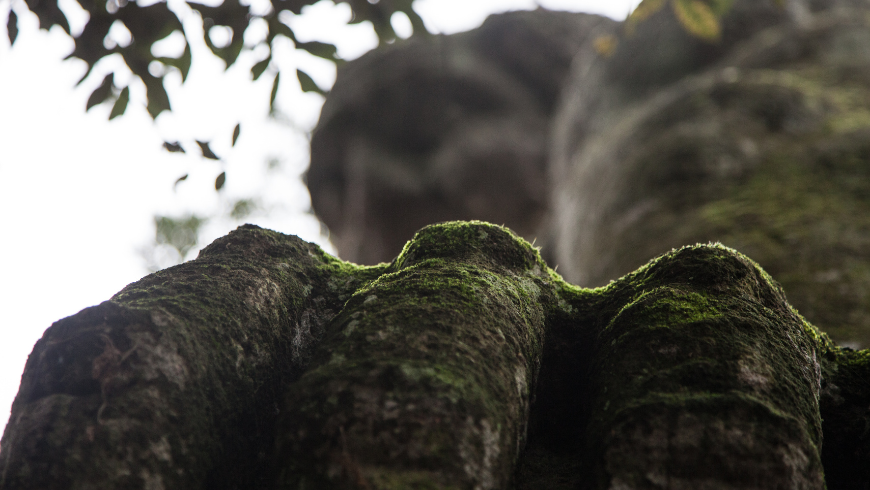
Compared with the refined Italian gardens of the same period, the Wood of Bomarzo follows a completely different path. Its forms do not seek order or symmetry: they are gigantic, surprising and sometimes unsettling. The vegetation is not simply a backdrop for the works. Rocks, trees and sculptures seem to belong to the same landscape, creating an environment where it is easy to lose one’s sense of proportion for a few hours.
And this is one of the secrets of the place: there is no single key capable of fully explaining the Sacred Wood. Over the centuries, they proposed many interpretations, linked to mythology, literature, symbolism and even esotericism, but the garden continues to leave room for the imagination of those who walk through it.
Why do we call the Sacred Wood the Park of Monsters?
The name Park of Monsters comes from the numerous fantastic sculptures found along the route. They include hybrid creatures, gigantic animals, deities and enigmatic figures carved directly into the stone.
Among the best-known figures is the great Ogre, a gigantic mask with a wide-open mouth that has become one of Bomarzo’s symbols. Nearby are an elephant carrying a tower on its back, sphinxes, a dragon, a giant tortoise and other figures that seem to emerge naturally from the woodland. At the entrance, two sphinxes appear to challenge visitors, while an inscription invites them to wonder whether the marvels of the place were created “by enchantment or by art”.
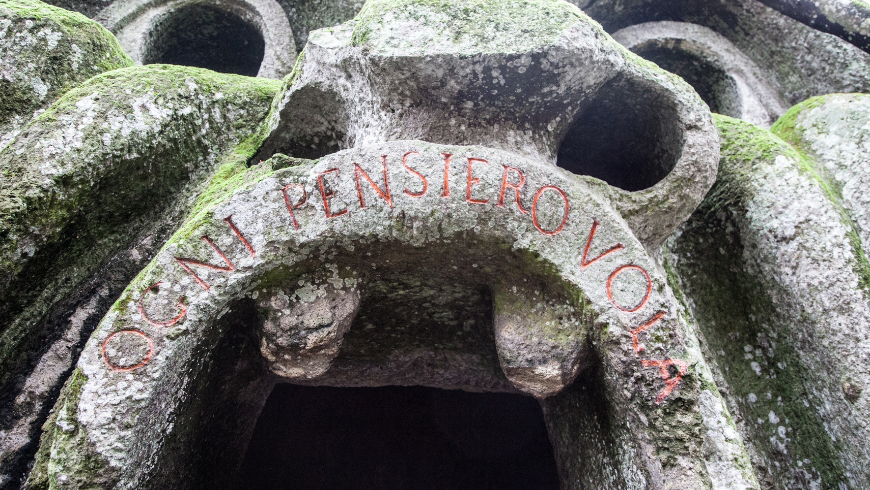
The relationship with nature also contributes to the garden’s uncanny atmosphere. The sculptures are not arranged like those in an open-air museum. They appear along the woodland paths, surrounded by vegetation, almost as if they had always inhabited this place.
Who created the Park of Monsters in Bomarzo?
Pier Francesco Orsini, known as Vicino, Lord of Bomarzo, commissioned the Sacred Wood during the second half of the 16th century. For a long time, the project was mainly associated with the architect Pirro Ligorio. More recent studies, however, have questioned the overall attribution of the project and the roles played by the various artists and architects involved in its creation.
What we do know is that Vicino Orsini transformed the landscape into a unique work. The result was very different from the more orderly and celebratory Renaissance models.
The Mystery of the Stone Monsters
The meaning of the sculptures is one of the most fascinating aspects of the Park of Monsters in Bomarzo. Why an elephant? Why a gigantic tortoise? What does the Ogre represent? And why do some figures seem to belong to a mythological world while others take on almost grotesque forms?
Over time, scholars proposed numerous interpretations. Some look to classical and Renaissance literature, others to symbolism, and still others to the period’s hermetic culture.
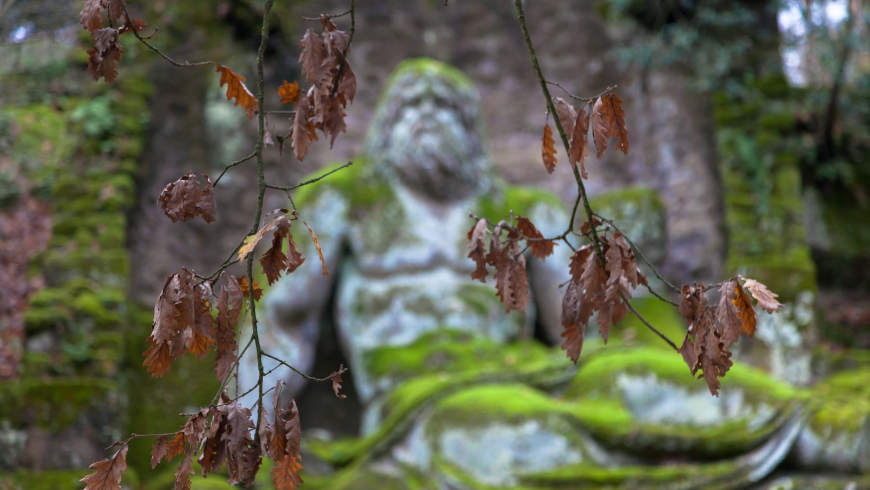
But perhaps looking for a definitive answer means losing part of the place’s fascination. The Sacred Wood has also been described as a true labyrinth of allusions and illusions, and its strength lies precisely in the possibility of being interpreted in different ways.
This is also why it is worth exploring the garden without looking only for its most photographed sculptures. In Bomarzo, the journey continues even when we stop looking for an answer.
The Forgotten History of the Sacred Wood
One of the lesser-known aspects of Bomarzo’s history is the long period during which the Sacred Wood was left in a state of neglect. After centuries of changes, the garden had gradually been swallowed by vegetation. By the mid-20th century, some of the sculptures were hidden, darkened and surrounded by woodland. Photographs from that period show a place very different from the one visitors can explore today.
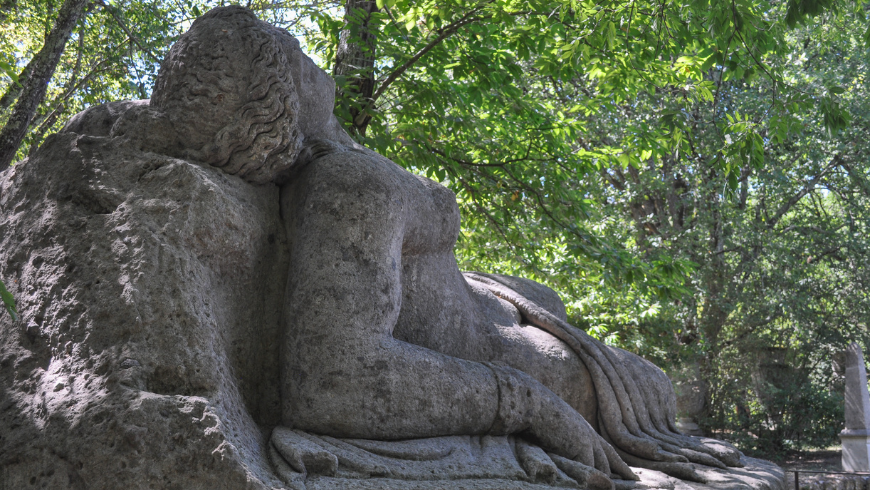
The restoration of the complex began in the 1950s, when Giancarlo and Tina Severi Bettini purchased the land in 1954 and undertook extensive work to clear and restore the sculptures and paths. Some sculptures were freed from the vegetation and, in some cases, reassembled, gradually making the route easier to understand and explore.
The Pyramid of Bomarzo: an Even Older Mystery
Bomarzo is home to an even older and more mysterious site. A short distance from the Park of Monsters, in the woods between Bomarzo and Chia, in the municipality of Soriano nel Cimino, stands the so-called Pyramid of Bomarzo, an imposing rock structure carved into volcanic stone.
Its function has not yet been fully established. Geological and archaeological studies indicate that the area was inhabited or used in very ancient times and consider the structure a monument of particular interest. The most widely accepted hypothesis is that it may have been a rock-cut altar associated with ritual practices dating back to the Etruscan-Roman period.
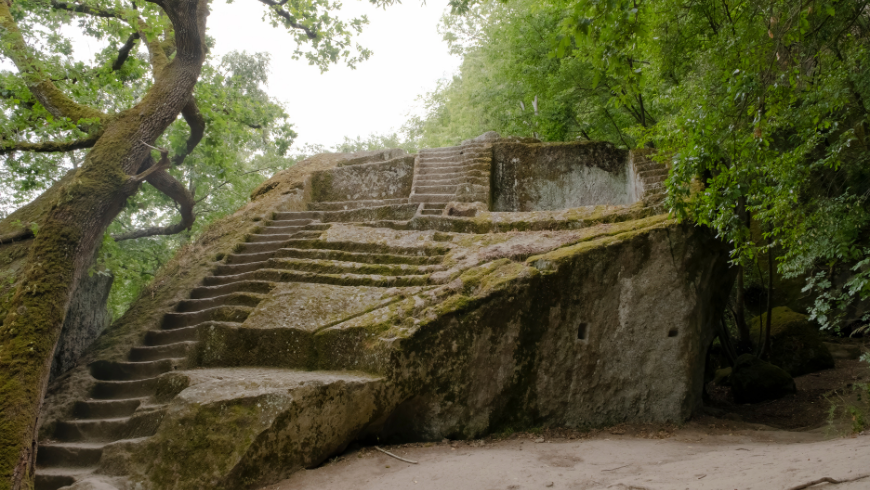
The Pyramid remained hidden beneath vegetation for a long time. The structure was rediscovered in 2002 and made accessible from 2008 thanks to the work of Salvatore Fosci, who oversaw the removal of vegetation and the restoration of the access paths.
The structure features a series of steps and carvings cut directly into the rock. Its exact function is still the subject of study and debate, and this uncertainty makes the experience all the more fascinating.
What to See Around Bomarzo
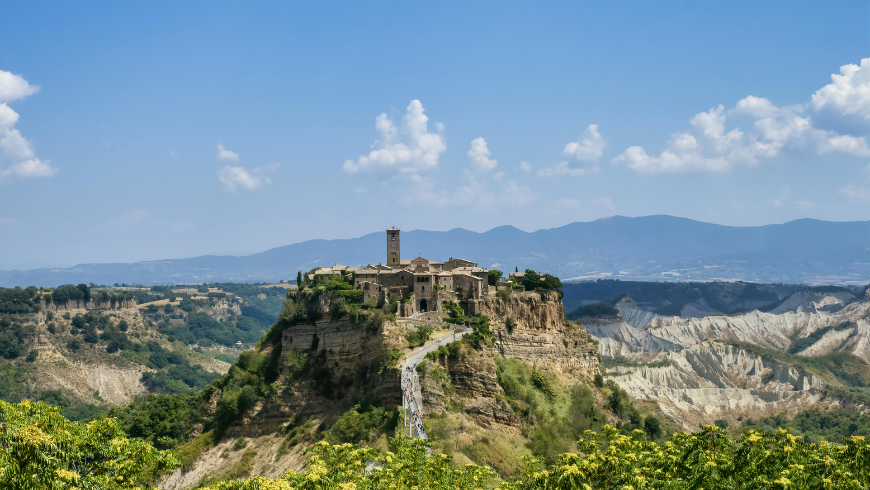
A visit to the Sacred Wood of Bomarzo also offers an opportunity to explore other fascinating places in Tuscia. Nearby are Viterbo, with its medieval centre and the San Pellegrino district; Soriano nel Cimino, at the foot of Mount Cimino; and, near Viterbo, the Etruscan necropolis of Castel d’Asso, surrounded by woodland. A little farther away lies Civita di Bagnoregio, perched above the Valley of the Calanchi. An itinerary through the area allows you to combine art, archaeology, villages, and natural landscapes, following the thread of a land rich in history and still capable of surprising visitors.
Where to Stay Near the Park of Monsters in Bomarzo
To explore Bomarzo and other places in Tuscia, an interesting option is B&B Casale Hortensiae, near Orte.
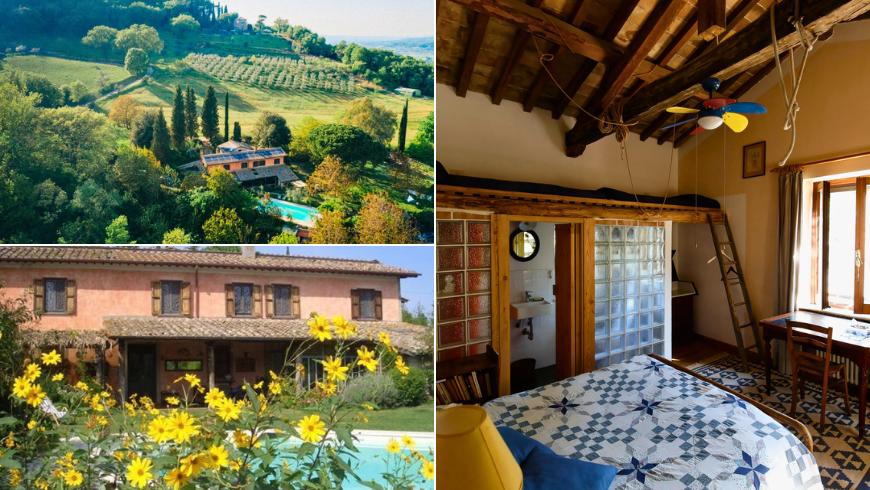
Surrounded by nature and overlooking the Tiber Valley, the B&B offers an authentic countryside experience and can be a convenient base for visiting Bomarzo, Viterbo, Orvieto, Lake Bolsena and other places in Tuscia. The property has a garden with a swimming pool and offers a delicious organic and plant-based breakfast. The hosts state that they follow several environmental practices in their everyday life, including the use of energy from renewable sources, the recovery and reuse of water, solar panels for heating water, and the use of ecological cleaning products. The property also holds ICEA Eco Bio Tourism certification.
The Via Amerina also passes by the property and can be explored on foot, by bicycle or on horseback, offering the opportunity to turn a visit to Bomarzo into a slower journey through the surrounding area.
 B&B Casale Hortensiae – Green Bed & Breakfast in Orte, Viterbo, Lazio, IT


