
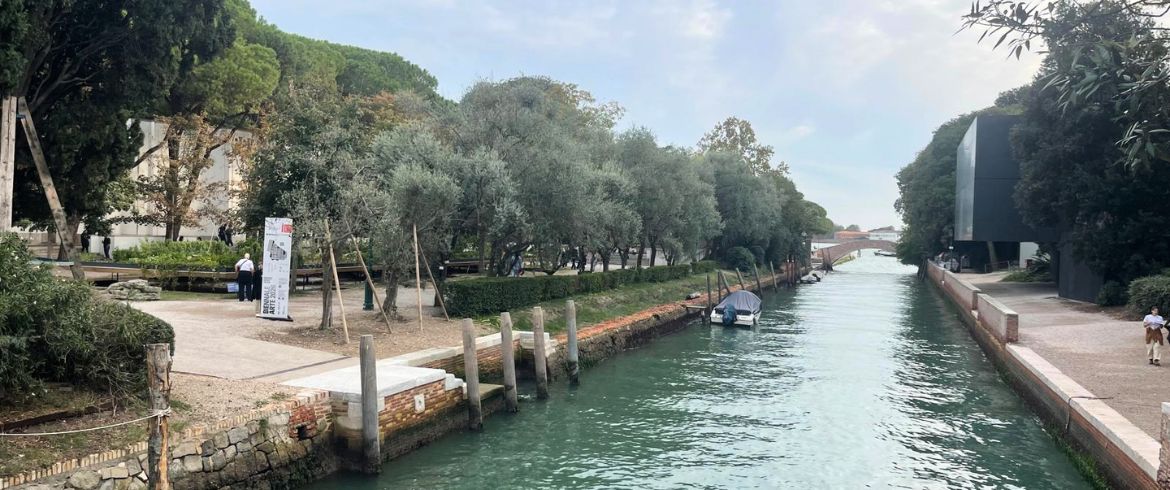
From the exhibition In Minor Keys to artworks exploring the relationship between people and the environment: four ways to discover a Biennale that challenges how we inhabit the world and invites us to rediscover the value of small things
I returned just a few days ago from Venice, where I visited the 61st Art Biennale. Among the galleries of the Arsenale and the national pavilions, some artworks stood out for their ability to address environmental issues without simply illustrating the climate crisis. They explore our relationship with nature, objects, resources, other living beings, and the places we inhabit.
This visit inspired me to revisit some of the artworks that made me think, looking for a common thread linking very different languages and stories. I found one in In Minor Keys, the international exhibition conceived by curator Koyo Kouoh, who died in 2025, and realised according to the project she had prepared.
The title evokes the minor keys of music, but it also suggests a different way of paying attention: turning towards what remains on the margins, towards voices that are heard less often, and towards forms of life and relationships that risk being obscured by the noise of contemporary society.
The exhibition invites us to question a model based on continuous growth, productivity, and accumulation, in which ecosystems and communities can become collateral damage. Featuring 110 participating artists, this Biennale offers a broader reflection on the relationship between people, nature, power, and the possibility of living differently.
In Minor Keys: four ways to look at the Biennale
During my visit, I found four possible ways of interpreting the exhibition particularly thought-provoking. They are not official categories used by the exhibition, but perspectives through which to consider certain artworks and the questions they leave open.
1. Listening rather than consuming
In a society competing to capture our attention, listening calls for a different kind of openness: pausing, observing, and accepting that not every experience needs to become a purchase, a performance, or content to share. Even visiting an exhibition can become an exercise in attentiveness, rather than a race between the most photographed artworks.
2. Recognising the rhythms of life
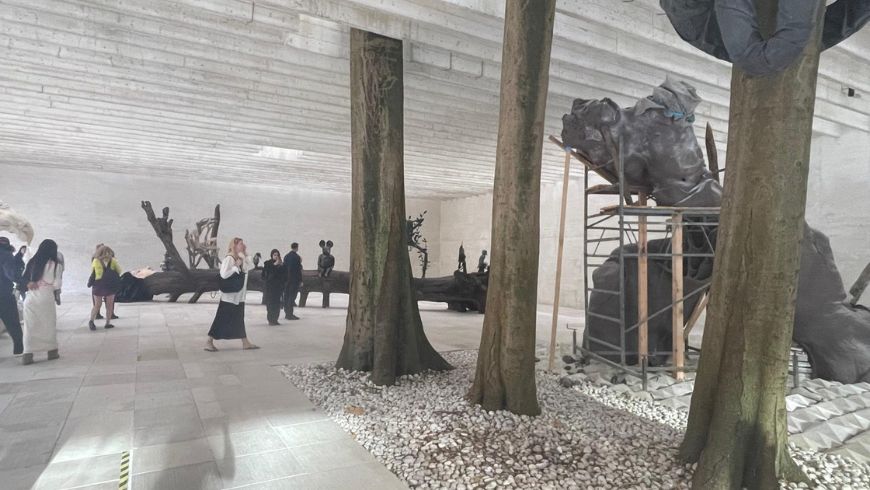
Otobong Nkanga’s plants, and the rocks and Arctic landscapes evoked by Alexa Kumiko Hatanaka, remind us that the natural world follows rhythms that do not coincide with those of the economy. Growth, regeneration, and adaptation cannot always be accelerated. This is a reflection on biodiversity, but also on the limits of a model based on continuous growth.
3. Looking beyond our immediate well-being
The works of Florentina Holzinger and the Nauru Pavilion draw attention to what often remains outside our field of vision: pollution, extracted resources, and environmental damage associated with our consumption patterns. The consequences do not disappear when we stop seeing them; often, other communities bear the cost. Sustainability thus becomes a matter of justice, not just efficiency.
4. Cultivating different ways of being together
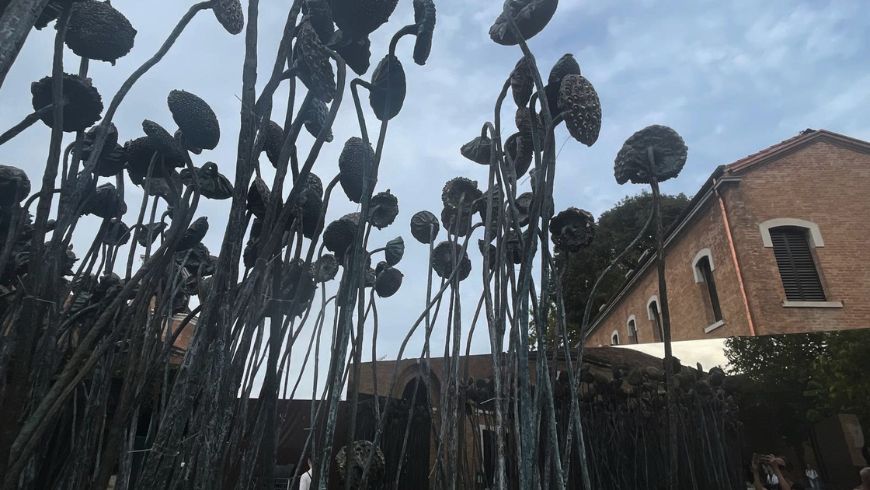
In Symbiosis, Xu Jiang creates a garden of bronze sunflowers and mirrors in which forms multiply and reflect one another, creating a landscape that invites us to consider coexistence and dialogue between cultures. The work suggests that our relationship with the world can be based not only on possession and control, but also on connection and the recognition of difference. Quality of life does not necessarily depend on accumulating experiences and possessions: it can also emerge from the bonds we are able to build.
The clothes we discard: Obroni Wawu by Victoria-Idongesit Udondian
At the Arsenale, a fortress-like structure combines industrial barrels, second-hand clothes, and discarded objects. It feels like an accumulation transformed into architecture: what we no longer want to see suddenly becomes impossible to ignore.
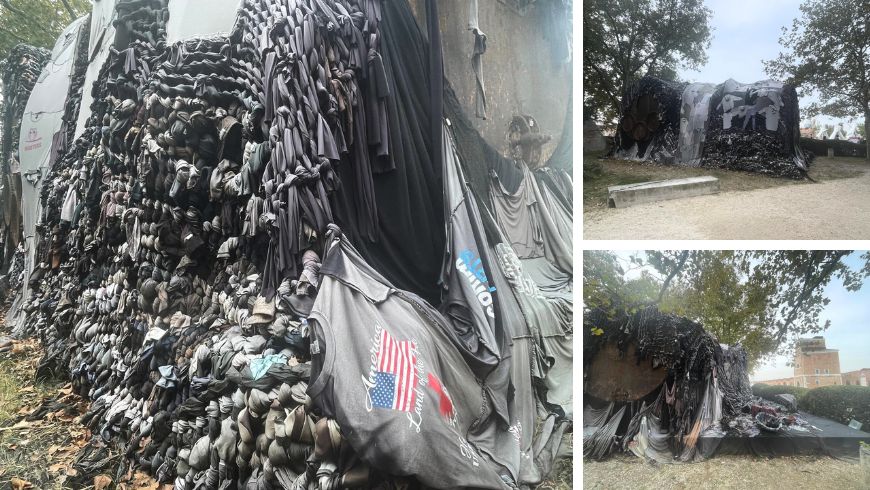
Victoria-Idongesit Udondian’s work, Obroni Wawu, explores the environmental and social costs of fast fashion and consumerism. The title, an Akan expression that can be translated as “dead white man’s clothes”, refers to the trade in second-hand clothes that reach African markets.
Behind an everyday act such as clearing out a wardrobe lies a complex geography of production, labour, transport, waste, and communities left to deal with the effects of consumption decided elsewhere. This phenomenon is also linked to so-called waste colonialism, meaning the transfer to other territories of waste and environmental costs generated by the consumption patterns of wealthier countries.
The work asks us to look beyond the moment when an object is no longer useful to us. Where does what we throw away end up? Who bears the cost? And how far away is the problem we think we have left behind?
When technology meets nature: Noospheres: Expanded by Michael Joo
Four large suspended LED screens display constantly changing abstract forms, with splashes of fuchsia, green, blue, and other shades. The images seem to belong to a moving digital universe, yet their connection with the natural world is tangible.
With Noospheres: Expanded, Michael Joo develops a work connected to Organic Growth: Crystal Reef, an ongoing project launched in 2021 that uses digitally generated crystalline forms and 3D-printing processes as part of a study of coral resilience off the coast of Kona, Hawaii.
The work explores the interplay between technology and natural systems, prompting reflection on how digital tools can help us study ecosystem resilience.
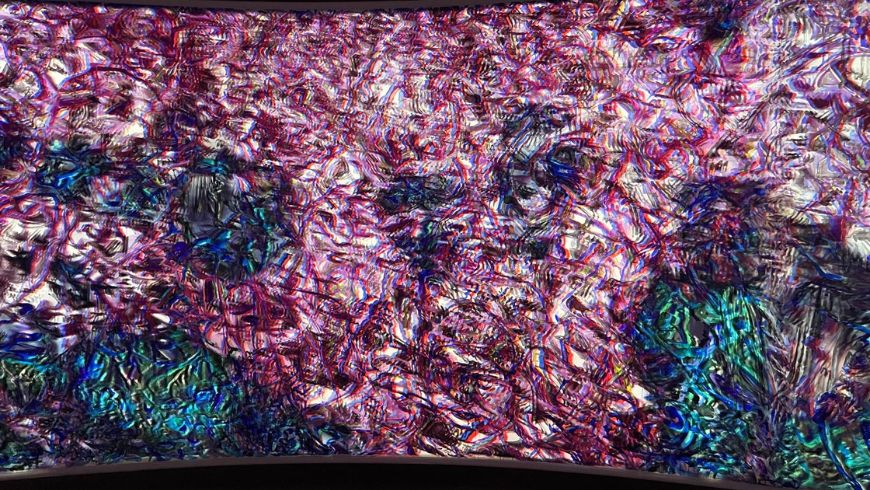
The work leaves us with an intriguing question: should technology serve only to accelerate production and consumption, or can it become a tool for understanding the living world better and learning how to care for it?
Knowledge at risk of disappearing: Alexa Kumiko Hatanaka
In the works of Alexa Kumiko Hatanaka, the Arctic landscape is not merely a distant setting. It is an environment understood through practices, observations, and knowledge that help people find their way and live in relationship with the land.
Her prints evoke snow formations used by Inuit people for navigation, now threatened by changes associated with rising temperatures. When the climate changes, it is not only the balance of ecosystems that shifts: knowledge built over generations can also lose its points of reference.
In Susceptibility to Gravity, meanwhile, Hatanaka draws inspiration from koinobori, traditional Japanese carp-shaped streamers. Made in collaboration with craftspeople who specialise in sailmaking, these forms billow in the wind. In Venice, where dealing with high water is part of city life, the work draws attention to the wind and the natural forces that shape places.
The work brings distant places into dialogue, showing that the environment is not an unchanging backdrop, but a network of conditions on which cultures, memories, and ways of life depend.
Otobong Nkanga: the invisible connections between land and life
In the Central Pavilion and the Sculpture Garden, Otobong Nkanga creates connections between materials, plants, and architecture. Local bricks wrap around some columns; ceramic pots hold plants whose roots and branches spread around the structures.
Other works evoke plant forms through Murano glass, while rocks from Italian quarries interact with rainwater and aromatic plants.
Materials are not inert elements to be used at will: they tell stories of origins, transformations, extraction, and ties to the land. A rock carries geological time within it; a plant grows according to rhythms we cannot fully control.
Nkanga’s works invite us to recognise these connections and to see nature not as a storehouse of materials to exploit, but as a network of which we are part. From this perspective, caring for the environment also means rethinking how we use resources and relate to the places around us.
The environmental costs we do not see: from Seaworld Venice to Nauru
In the Austrian Pavilion, Florentina Holzinger transforms the space into an environment that evokes a water park, a water-treatment plant, and a place of ritual. In Seaworld Venice, the human body, water, and technology enter an unsettling relationship in which what appears clean and what is considered contaminated are no longer easily distinguished.
Water is an unavoidable presence in the life of the lagoon city, but it is also the medium through which the contradictions in our relationship with the environment become visible. The infrastructure that protects us, the systems that treat waste, and what is kept out of sight all belong to the same landscape. The work offers no simple solution: it invites us to confront everyday waste, the consequences of our activities, and the vulnerability of bodies and ecosystems.
Another perspective emerges from the pavilion of the Republic of Nauru, entitled AIM Inundated: Imagining Life After Land. The project draws attention to a Pacific island vulnerable to the effects of rising sea levels, whose history is also marked by intensive phosphate mining. This activity has removed much of the island’s interior and damaged large areas of its territory, leaving profound consequences for the land and its population.
The project invites us to imagine what it means to live when land, regarded for generations as a secure foundation, becomes fragile or is damaged. It is a question about the future, but also about present-day responsibility: who benefits from the exploitation of resources, and who inherits the damage?
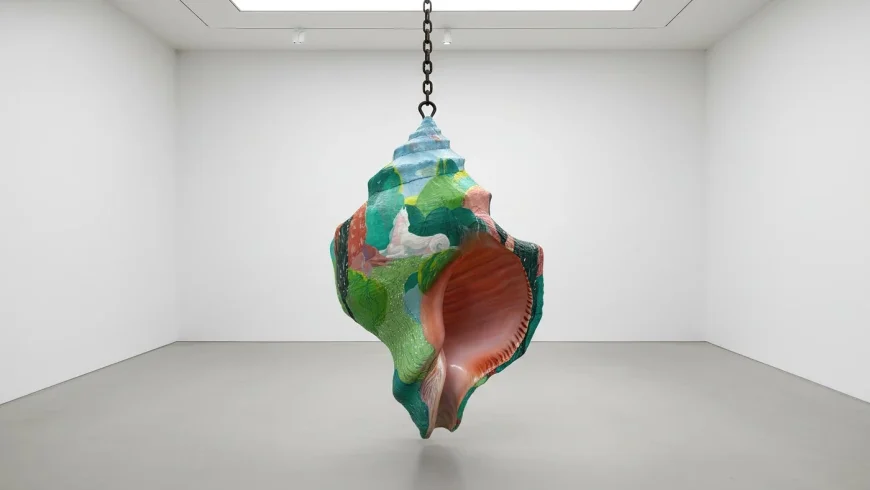
These are different contexts, but both encourage us to look beyond our immediate well-being. Extracted resources, pollution, and environmental damage do not disappear when they move out of our field of vision: other communities often bear the cost. The ecological crisis does not distribute its consequences fairly. Sustainability must therefore include justice, memory, and responsibility towards the communities most exposed to harm.
Geographies of Distance: Remembering Home: when the land changes, the idea of home changes too
At the India Pavilion, Geographies of Distance: Remembering Home brings together artists reflecting on the relationship between places, memory, and cultural transformations.
Asim Waqif’s bamboo structures evoke the scaffolding used in construction and suggest a reflection on urban growth and the loss of collective memory. Skarma Sonam Tashi’s papier-mâché architectures, meanwhile, evoke Ladakh, a Himalayan region where development is putting pressure on the landscape and the cultural memory of places.
In these works, the environment is inseparable from culture: available materials, ways of inhabiting a place, and knowledge passed down through generations help define a place’s identity. When a territory changes rapidly, our connection to home can also become more fragile.
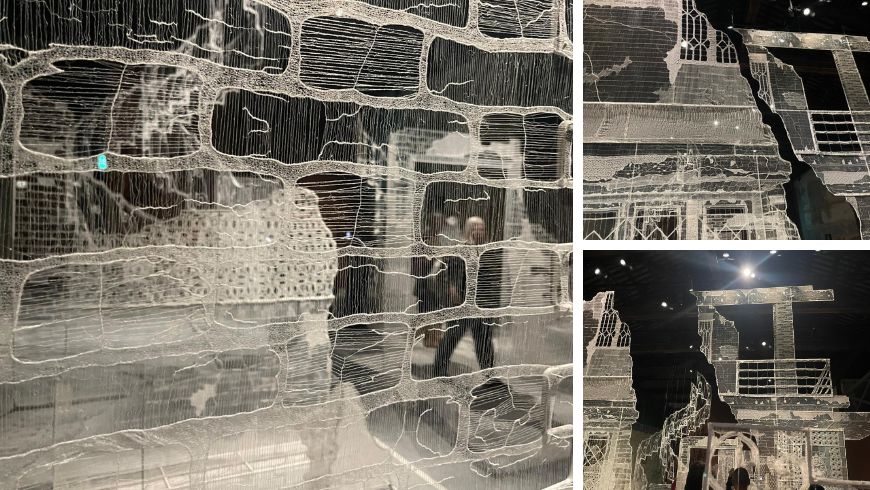
The pavilion suggests that preserving a heritage does not mean freezing it in the past. It means recognising the value of the relationships between people, materials, landscapes, and knowledge, and asking what can be passed on to future generations.
Don’t Get Me Wrong: rediscovering the human scale
At the Lebanese Pavilion in the Arsenale, Nabil Nahas presents Don’t Get Me Wrong, an immersive installation made up of 26 large painted panels arranged in a continuous frieze. Along the route, amid rubble, sand, and bricks scattered on the floor, the amplified sounds of footsteps also shape the perception of the space, making visitors part of the experience.
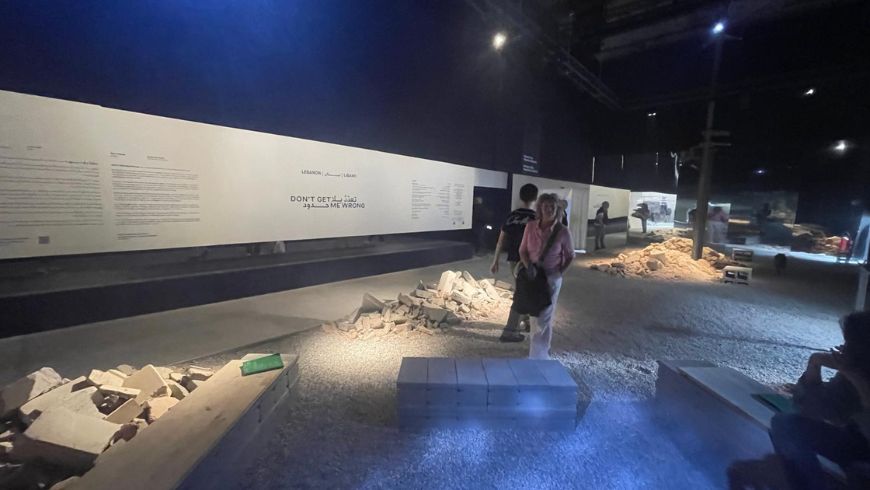
Geometric shapes, figurative elements, and structures reminiscent of fractals create a visual universe in which nature seems to expand far beyond the human scale. The work does not directly address the climate crisis, but opens up a reflection on the relationship between human beings, the cosmos, and the complexity of the world. The forms suggest that what we observe can exist simultaneously at different scales, from the infinitely small to the infinitely large, reminding us that humanity, too, is part of something much greater.
From this perspective, human beings are not the absolute centre of everything that exists. Recognising our place in the world can be a first step towards accepting its complexity and the need to coexist with what we cannot control.
Another way of seeing the world
As I returned from Venice, one feeling stayed with me above all: many of the works that moved me do not simply ask to be looked at; they ask us to rethink something about the way we live.
The discarded clothes, corals, plants, rocks, water, and territories scarred by extraction tell different stories, yet they seem to lead back to one common question: what happens when we see the world only in terms of what we can take from it?
Not all these works speak directly about the climate crisis. Some invite us to look closely at materials, while others encourage us to recognise the fragility of territories or the inequalities that accompany resource exploitation. Together, they create space to question the idea that nature is something separate from us, available for use without consequences.
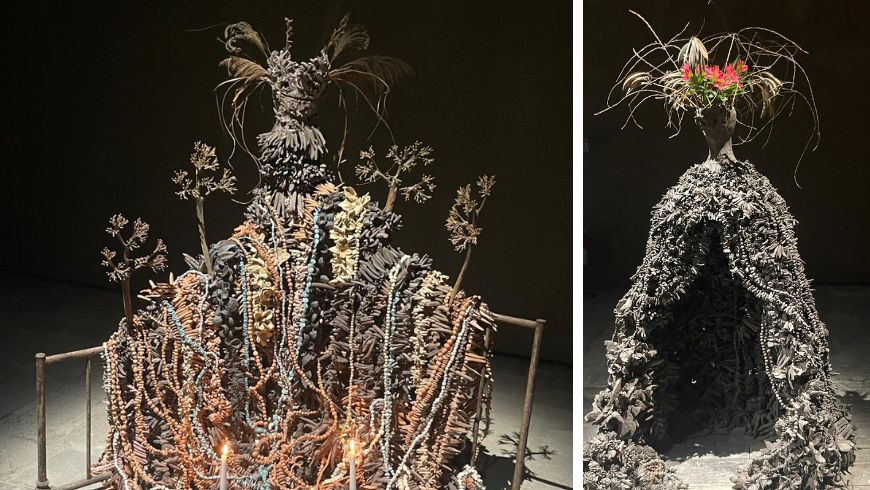
This Biennale invites us to pay closer attention to what usually remains in the background. Listening rather than consuming does not mean giving up experiences, but living them differently. It means looking with curiosity, recognising connections, respecting natural rhythms, and remembering that quality of life does not necessarily depend on accumulation.
Cover image: photo by S. Ombellini
 Ca' Riza Residenza Tipica Veneziana – Green Bed & Breakfast in Venice, Venezia, Veneto, IT


