Rare earth elements have become one of the most strategic resources of the 21st century. Invisible to the naked eye yet essential to modern digital life, they power smartphones, artificial intelligence, electric vehicles, wind turbines, and advanced defense systems.
Today, they are at the center of a global competition that intertwines geopolitics, technology, and the energy transition. But behind this revolution lies a deep paradox: the more indispensable they become, the more their extraction reveals environmental fragility and global economic imbalances.
What are rare earth elements: definition and characteristics
Rare earth elements are not “rare” in the strict sense of the term. They consist of 17 chemical elements present in the Earth’s crust in relatively widespread amounts.
Their name comes from a historical misunderstanding: in the 18th century, these elements were difficult to isolate and separate from surrounding minerals, and were therefore considered rare.
In reality, the issue is not their abundance, but their dispersed distribution: they are not found in concentrated deposits like gold, but are mixed in trace amounts within other minerals. This makes extraction and especially refining a complex, costly, and highly impactful process.
From smartphones to jets: where critical metals are found
These raw materials are essential across many sectors, including technology, defense, electric mobility, wind energy, and healthcare, to name only the most important fields.
Rare earth elements are the silent backbone of modern technology.
They are found in:
- medical devices and military systems
- smartphones and computers
- LEDs and displays
- batteries and electric motors
- solar panels and wind turbines
Why rare earth elements are strategic today
Global demand for rare earth elements is rapidly increasing, driven by three major trends:
- the energy transition toward renewable sources
- the rise of electric vehicles
- the development of artificial intelligence and digital hardware
This combination is turning rare earth elements into a crucial and contested resource, increasingly central to the economies of the future.

Who controls rare earth elements: China, the USA and global geopolitics
Rare earth extraction is not evenly distributed around the world.
Currently:
- China dominates the sector with around 70% of global production
- the United States is the second-largest producer
- followed by Australia and Myanmar
But the real critical point is not extraction: it is refining, a stage in which China controls around 90% of global processing.
This means that even rare earth elements extracted elsewhere are often sent to China for processing, reinforcing a strong global dependency.
Environmental impact of rare earth extraction
Rare earth extraction has a significant environmental impact. On average, one ton of extracted material generates about 1.4 tons of radioactive waste (solid, liquid, or gaseous), as well as one ton of wastewater contaminated with ammonium sulfate and heavy metals.
These figures help illustrate the scale of the issue, which becomes even clearer when looking at real-world examples.
The case of Bayan Obo mine (China)
The Bayan Obo mine, the largest in China, is one of the most significant examples. Every year, for about 100 tons of concentrated rare earths, up to 200 tons of thorium dioxide waste are produced, a radioactive byproduct that represents a serious environmental concern.
Processing plants in Malaysia
In Malaysia, some rare earth processing plants were shut down due to severe environmental impacts.
The main issues identified include:
- water contamination
- emissions and greenhouse gas production
- pollution linked to refining processes
These cases show that the impact is not limited to extraction, but extends to industrial processing stages as well.
Research and studies on pollution
At an international level, several studies are underway. Some focus on developing technologies to contain and manage radioactive waste, while others aim to recover rare earth elements directly from industrial and mining residues.
The goal is twofold: to reduce environmental impact and to improve resource recovery efficiency.
The “urban mine”: the potential of electronic waste
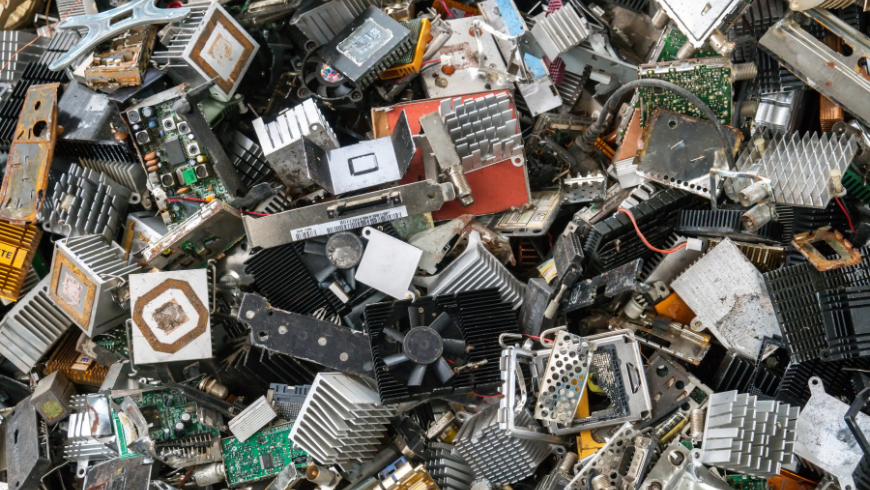
Electronic waste (e-waste) represents both an environmental challenge and a potential source of critical raw materials, including rare earth elements.
Data shows a steady increase in the phenomenon: in 2019, around 53.6 million tons of electronic waste were generated globally.
Despite this enormous volume, today we recover less than 1% of rare earth elements contained in electronic devices.
The challenge is structural: these critical metals are present in very small quantities, and electronic devices are not designed for easy recycling. They are “sealed” and require multiple complex and costly steps to extract even small amounts of valuable materials.
Circular economy and the future of rare earth elements
The future of rare earth elements necessarily requires a paradigm shift toward a circular economy.
The main development directions include:
- improving recycling technologies
- designing devices that are easier to disassemble
- stricter regulations on e-waste recovery
- research into alternative and substitute materials
- turning waste into a strategic resource
However, current recovery technologies are still under development and not sufficient to meet growing global demand.
Are there alternatives to rare earth elements?
At present, there are no truly scalable and competitive alternatives capable of fully replacing rare earth elements in advanced technologies.
This makes it even more urgent to:
- reduce dependence on concentrated supply chains
- invest in research and innovation
- develop more sustainable and diversified supply networks
- improve large-scale recycling systems
Conclusion: a challenge between technology and sustainability
Rare earth elements embody the paradox of our time: they are essential for building the digital and energy future, yet their extraction places increasing pressure on already fragile ecosystems.
This is not only a technological or geopolitical challenge, but a systemic choice: whether to continue relying on a few extraction and refining hubs, or to radically rethink how we produce, consume, and recycle materials.
The future of rare earth elements will not be decided only in mines, but in our ability to develop circular economies, material innovation, and large-scale electronic waste recycling.
Because the most strategic resource of the future will not only be what we extract from the Earth, but what we are able to give back to it.
Cover photo source: Canva Pro