

Tourism is never neutral. Every choice of travel, hospitality and economic collaboration contributes to shaping the world in which we live. For this reason, Ecobnb has decided to adhere to the campaign Spaces Free from Apartheid Israel (SPLAI). Therefore, we promote a deep reflection on the ethical role of tourism and of accommodation facilities.
In recent years, the debate on sustainable tourism has developed beyond the environmental dimension alone. In fact, it is increasingly recognized that traveling, hosting and choosing tourist platforms and services also entails a social and ethical responsibility.
Tourism is a global sector that connects people, economies and territories. But precisely for this reason it can’t be considered neutral to injustice, inequality or human rights violations.
Global tourism and the invisible impacts
In an increasingly interconnected world, tourism also participates in the global dynamics of resource distribution, access to rights, and land management.
Some tourism practices can foster inclusion, decent employment, and the valorization of local communities. Others, however, risk fueling labor exploitation, the expulsion of residents from urban centers, overtourism, excessive resource consumption, or even financial support for contexts marked by illegal occupation and discrimination.
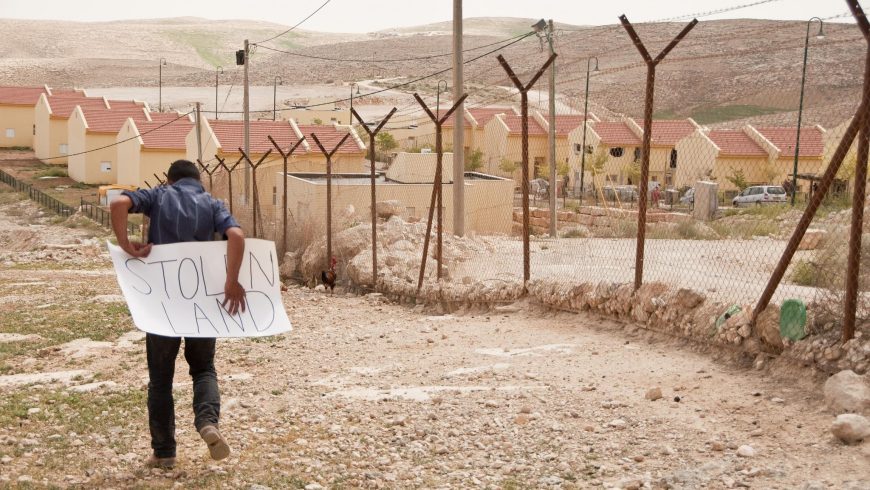
In recent years, several international organizations, NGOs, and civil society movements, such as BDS (the Palestinian-led international movement for freedom, justice, and equality), have highlighted that some large tourism platforms continue to promote accommodations situated in territories subjected to controversy and violations of international law. Even a simple reservation can have ethical and political implications that are often barely visible to travelers.
According to a report by Amnesty International, some of these activities contribute economically to the maintenance and expansion of Israeli settlements in the occupied Palestinian territories. This is illegal under international humanitarian law.
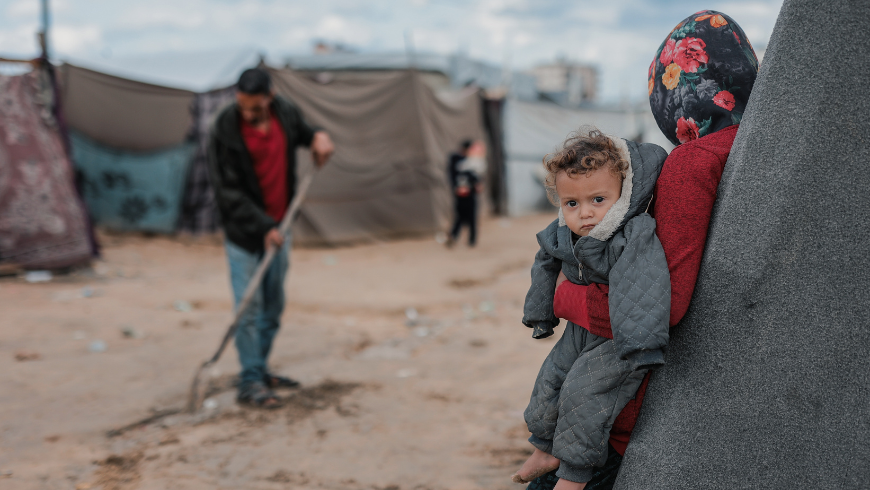
In these contexts, tourism is no longer just an economic sector. It becomes part of systems that impact access to land, resources and the freedom of movement of local communities.
Ecobnb and the choice to adhere to SPLAI
In this context, Ecobnb has decided to adhere to the campaign Spaces Free from Apartheid Israel (SPLAI). This is an international network of entities that promote social justice, equality and non-discrimination.
At the same time, the Ecobnb network also offers accommodation facilities voluntary tools for reflection and commitment, such as ethical hospitality initiatives “Oasi di Pace”. The aim is to encourage more conscious, inclusive tourism models consistent with the values of social and environmental sustainability.
What is SPLAI
The campaign Spaces Free from Apartheid Israel (SPLAI) is an international network of physical and virtual spaces that declare their commitment to the principles of freedom, justice and equality. Among these spaces there are associations, cultural centers, accommodation facilities and social entities.
The idea of the campaign is to create a network of spaces that explicitly declare that they do not want to collaborate with entities considered to be involved in violations of Palestinian rights. For example, associations, clubs, bookstores, businesses, cultural centers, commercial activities, collective and other public or private spaces.
SPLAI promotes the creation of spaces that commit to:
- support the Palestinian cause through forms of non-violent pressure;
- promote the economic, cultural and institutional boycott of Israeli and companies considered complicit in the occupation;
- not collaborate with institutions or companies linked to the Israeli state;
- raise public awareness of Palestinian rights.
Those who adhere to the campaign generally commit to:
- not to buy or sell products from companies involved in the disputed Israeli decisions;
- not to host events sponsored by Israeli institutions;
- disseminate campaign materials and initiatives.
The campaign is part of the broader international Boycott, Divestment and Sanctions (BDS) movement.
A tourism that changes perspective
Within this debate, sustainable tourism takes on a broader meaning. It is no longer just about environmental impact, but also how tourism relates to rights, people and territories.
The SPLAI campaign focuses on:
- respect for human rights;
- social responsibility of tourism companies;
- transparency in economic relations;
- promotion of more conscious hospitality practices.
From this perspective, tourism is a system that produces concrete effects on territories and people.
How can your accommodation facility adhere to the SPLAI campaign
If you have an accommodation facility and you share the principles of the campaign, then you can adhere to it by following these steps:
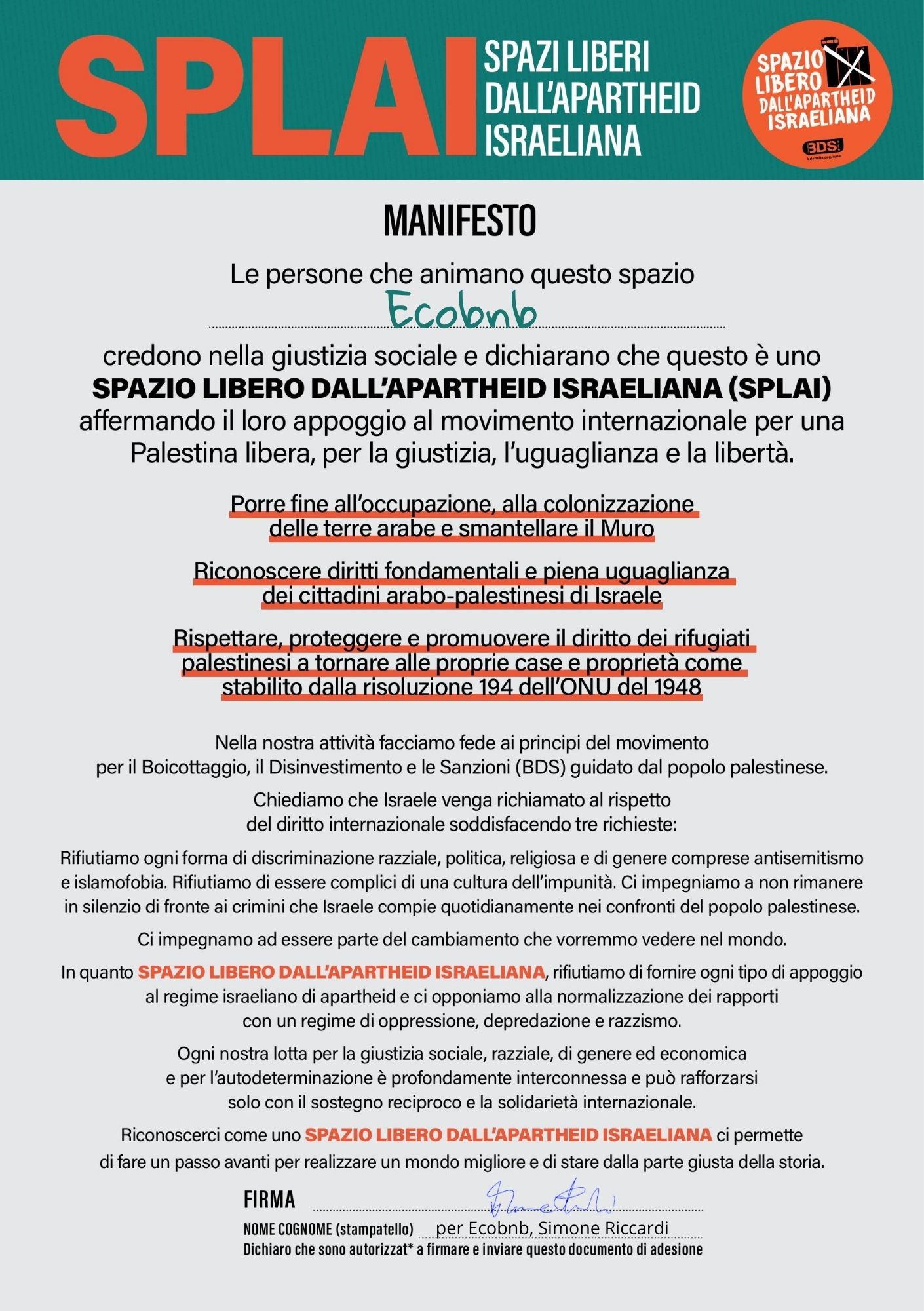
- Fill out the SPLAI Official Membership Form
You need to enter your business details and request to participate. - Receive the campaign information kit
After the evaluation, you will be sent instructions and dedicated materials. - Sign up for the membership manifesto
Sign the official campaign document with the name of your accommodation. - Send confirmation and become a partner
Once the process is complete, your facility enters the SPLAI network.
The “Oasi di Pace”: a proposal for the accommodation facilities

Alongside SPLAI, there is another initiative aimed at the hospitality sector: the “Oasi di Pace”, included in the international campaign “No Room for Genocide“.
This is a network of accommodation facilities that publicly declare their commitment to ethical and responsible hospitality, based on:
- respect for human rights;
- promotion of sustainable and ecological tourism;
- rejection of racism, sexism and all forms of discrimination;
- exclusion of relationships with individuals involved in serious violations of rights;
- protection and respect of staff, spaces, local communities and local culture.
How to adhere to “Oasi di Pace”
In this case too the adhesion is voluntary and simple:
- Send an expression of interest to the addresses indicated in the campaign
- Declare your commitment to inclusive and non-discriminatory hospitality
- Receive instructions to enter the international network
The accommodations that adhere can promote their commitment through the website of Ecobnb, communicating their membership to “Oasi di Pace”, sharing via social media and online channels and strengthening their identity as ethical hospitality.
Last thoughts
The future of sustainable tourism will not depend only on new technologies and fewer emissions, but also on the ability of the sector to reflect on its social impact.
With the adhesion to the international networks and the proposal of concrete tools for accommodations, Ecobnb continues to support a specific idea of tourism. A form of tourism that doesn’t only reduce its environmental impact, but also actively contributes to the creation of a more just and responsible society.
Cover photo via Canva PRO