
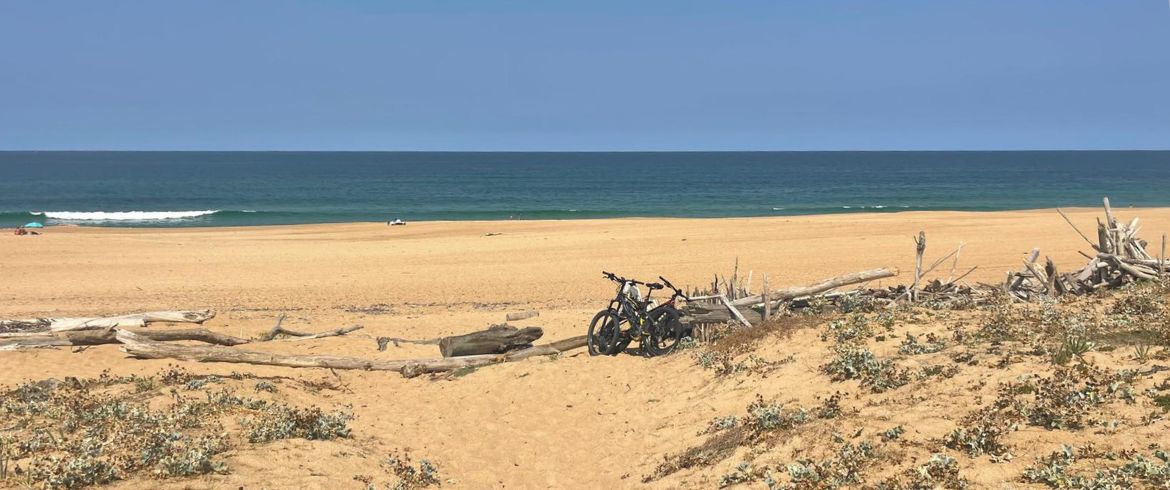
A slow journey by bike discovering Ondres, the beaches and pine forests of the Landes, following the Vélodyssée to the Adour and the French Basque Country.
The beauty of Seignanx lies first and foremost in its location. To the west is the Atlantic Ocean, with the vast sandy beaches of the Landes. To the south, beyond the Adour River, lies the French Basque Country, with Bayonne and Biarritz. Towards the east, the landscape changes again, giving way to countryside, wetlands and inland areas, all the way to the Vallée du Kiwi.
It is an ideal location for anyone who, during a holiday, does not want to choose between the sea and culture, nature and gastronomy, sports and small villages. And then there are cycle paths, walking trails and countless activities connected with nature.
Ondres: our starting point by the ocean
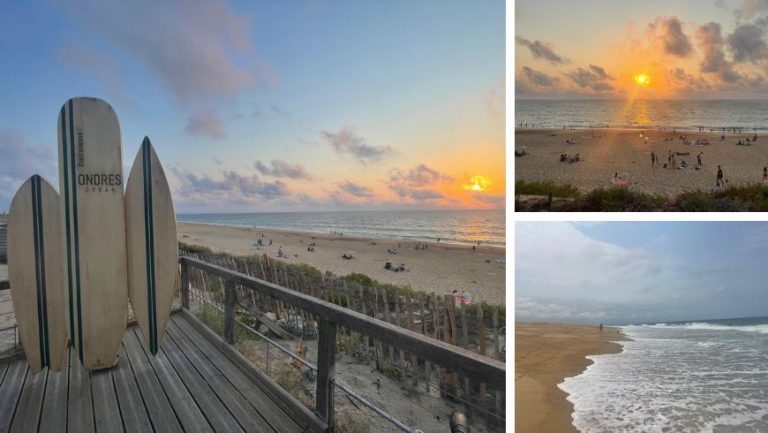
We chose Ondres as our base for exploring the Landes. It is a small coastal town, quieter than nearby Biarritz and Hossegor, where life still revolves around two elements that deeply define this territory: the beach and the forest.
The town and the ocean are connected by a road of about three kilometres, which is also followed by the Vélodyssée. The route can be travelled on foot or by bicycle, or, during the summer, by using the shuttle that connects the town centre with the beach.
In the heart of the town there is a small church with a pointed bell tower, a lovely playground and the fronton, the traditional court used for Basque pelota. Stopping to watch a game is a simple and authentic way to discover the local culture and the traditions that still bring the villages of Seignanx to life.
The beach is wide and sandy, backed by a belt of dunes. In the distance, towards the south, you can see the Basque mountains. Throughout the day, the scene is constantly changing: families, children, surfers, people walking along the shoreline and cyclists arriving from the pine forest. It is a lively beach, but it never feels like a seaside resort completely dominated by tourism.
And for those who, like us, travel with a dog, Ondres has an important advantage. Outside the regulated beach area, dogs are generally allowed, although they must be kept on a leash at access points and in accordance with local regulations. During the bathing season, they are not allowed in the supervised area. The municipality specifies that the regulated area is clearly marked and that dogs are tolerated outside it.
For us, this meant being able to truly enjoy the beach together with our dog, find a free stretch of sand and swim in the ocean with him, instead of having to leave him at home.
The great beaches of the Landes: ocean, dunes and freedom
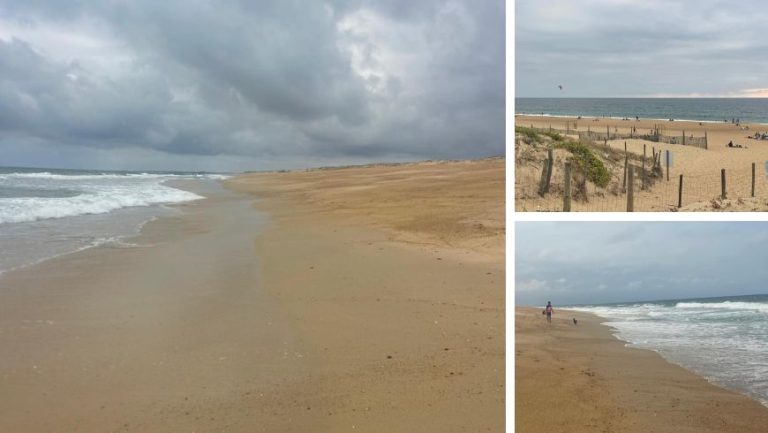
When you think of the Landes, it is hard not to think of the beach. The sandy coastline of the Landes forms a vast stretch of around 140 kilometres, bordered by dunes. In summer, this natural space becomes a huge open-air playground: people walk, swim, build sandcastles, surf, bodyboard, paddle or simply lie down and listen to the ocean.
Between Ondres and Tarnos there are around 8 kilometres of beach, enough to find your own spot even during the busiest periods.
But what we liked most was the relationship between the beach and what lies immediately behind it. There is no long succession of buildings separating the ocean from the natural environment: there are the dunes, followed by the pine forest. And this is precisely where you need to slow down.
Walking or cycling through the Landes forest
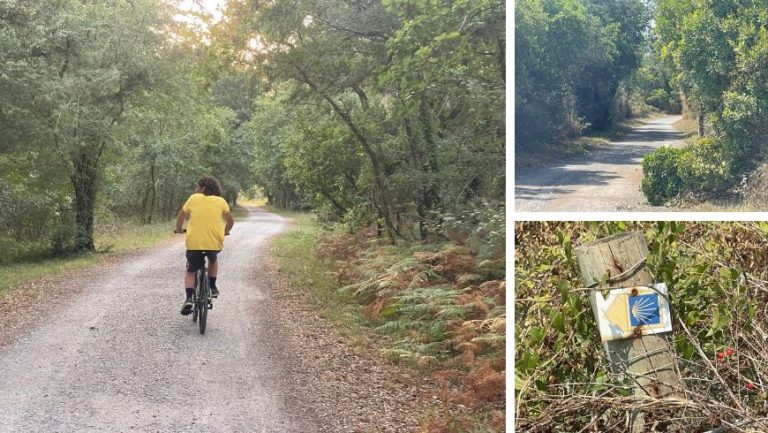
Maritime pines, cork oaks and strawberry trees alternate, with their slender trunks, cool shade and that forest scent that envelops you within just a few steps. The Landes forest covers almost one million hectares and is crossed by a dense network of trails and cycle paths, allowing you to explore it on foot, by bicycle or on horseback. The Camino de Santiago de Compostela, along its Northern Way route, also passes through these trails and can be recognised by its characteristic scallop-shell signs.
During our two weeks in Ondres, we made extensive use of the bicycle. It is one of the best ways to discover the area: you leave the town, cycle through the pine forest and, almost without noticing, arrive at the ocean.
The road connecting the centre of Ondres to the beach is accompanied by the Vélodyssée, the great cycle route along the French Atlantic coast, while a network of trails allows you to venture into the forest and discover an ever-changing landscape.
For those who love slow travel, this is perhaps one of the most beautiful features of Seignanx: here, cycling is not simply an activity to enjoy on holiday, but a genuine way to move around, explore and get to know the area.
The Vélodyssée: cycling between ocean and forest
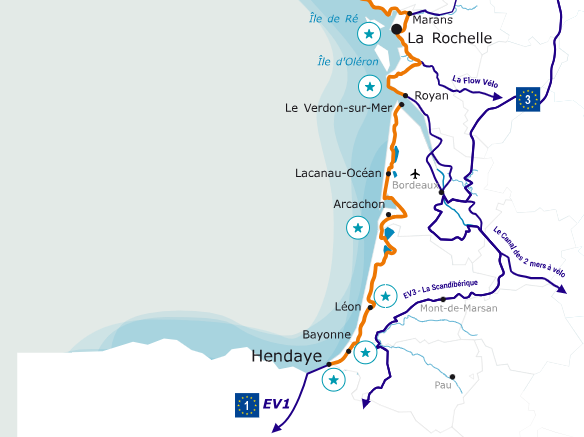
One of the reasons we chose to explore Seignanx by bicycle is that the Vélodyssée passes through here, the great Atlantic cycle route that crosses France from Roscoff in Brittany to Hendaye, near the Spanish border. It is the French section of EuroVelo 1 and follows the ocean for more than 1,300 kilometres.
In Ondres, the Vélodyssée runs right along avenue de la Plage, the tree-lined road connecting the town to the ocean for about three kilometres. You can start cycling, cross the town and then gradually immerse yourself in greenery, among pine trees, oaks and mimosas, until you reach the beach.
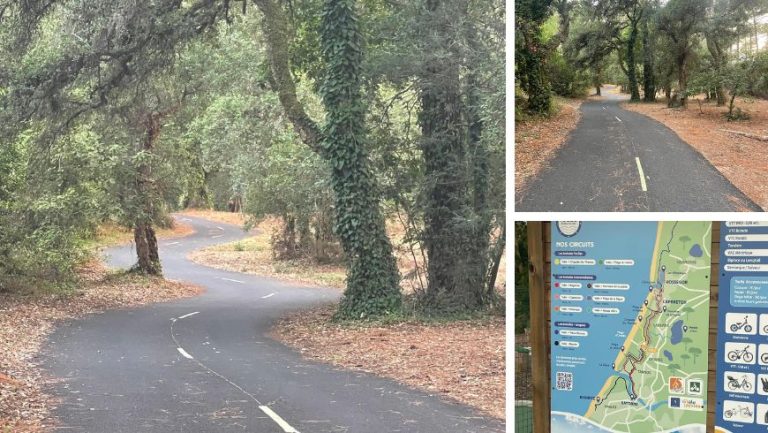
From here, you can continue north through the forest towards Labenne and Hossegor, or cycle south through Tarnos and Boucau to reach Bayonne. The local route is mostly flat, and there are several protected cycle paths, making this area particularly enjoyable even for those who are not experienced cyclists.
For those who want to take a longer excursion, there are several routes starting from Seignanx. One option is the Ondres–Bayonne route, around 45 km round trip: it starts from Ondres beach, passes through Tarnos and Boucau and reaches Bayonne. The route is mostly on cycle paths, although a few short sections require sharing the road with traffic.
But you do not need to cycle for hours to enjoy the Vélodyssée. A much easier option is the circuit between the beaches of Ondres and Tarnos, around 20 km, flat and suitable for families. The route mainly crosses the pine forest and allows you to reach Plage du Métro and then Plage de la Digue, where the landscape already begins to take on a character closer to the Basque coast.
This is precisely one of the best ways to discover Seignanx: without necessarily looking for a destination, but simply letting the road, the scent of the pine trees and the sound of the ocean guide you.
Dunes and pine forests: a biodiversity treasure
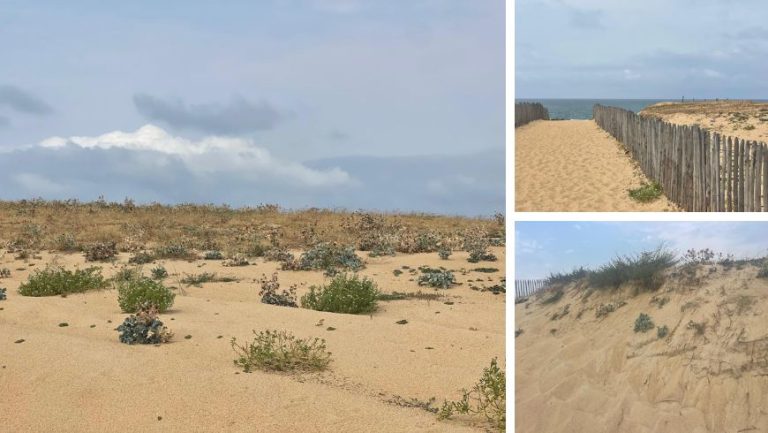
The beauty of the Landes coast is also its fragility. Dunes are not simply large accumulations of sand: they are a delicate ecosystem that protects the coast and provides a habitat for species adapted to difficult conditions, including wind, salt, sun and scarce water.
Among the dune species found in Seignanx are sea lilies, sweet woodruff, corbeille d’or, ocellated lizards and several species of larks.
That is why it is important not to cross the dunes freely, but to use the designated access points and paths.
Leaving on the beach everything we brought with us is also part of responsible travel. Local management authorities encourage visitors to take their waste with them and to respect the so-called laisse de mer, the collection of natural materials deposited by the tides, which plays an important role in the beach ecosystem.
Bunkers on the beach: traces of the Atlantic Wall
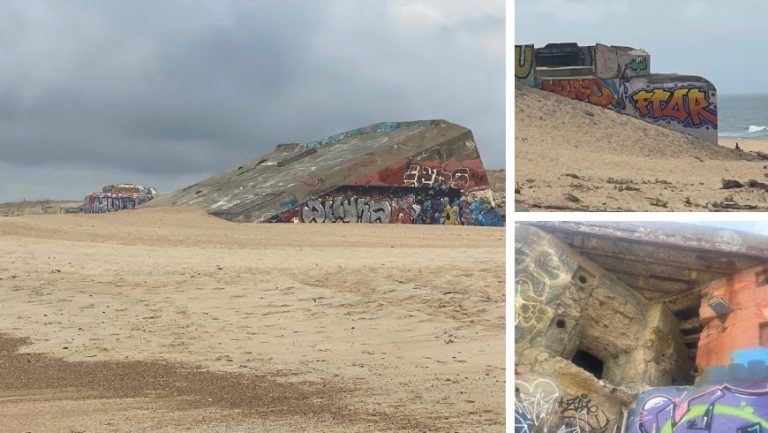
And then there are the bunkers. Walking along the beaches of Ondres and Seignanx, you may come across large concrete structures that today look almost surreal within the landscape. Some are covered in graffiti, while others are slowly being engulfed by sand and vegetation. Seeing them alongside surfers, beach towels and surfboards feels strangely out of place.
These structures are, however, traces of a much darker history: they are part of the Atlantic Wall, the system of fortifications built by Nazi Germany along the coasts of Western Europe during the Second World War.
At Ondres, position Ba 17 originally included two R 612 casemates and three anti-aircraft defence positions. Today, one of the two casemates has been destroyed, leaving one remaining, along with other traces of the position and an old German track.
What is striking is the way these structures now coexist with the landscape. The reinforced concrete that once served warfare has become a surface for street art; vegetation and sand are slowly changing its appearance. The bunker is no longer what it once was, but it still has a story to tell.
For those who want to learn more, the AtlantikWall Explorers project is documenting and studying the Atlantic Wall bunkers along this part of the coast. It is a detail worth looking out for during a walk: learning to read a landscape also means recognising the traces of its history.
Labenne: nature, biodiversity and contemporary art
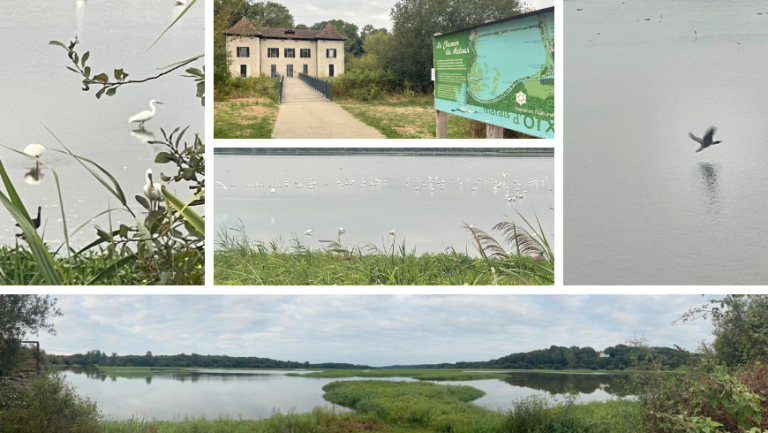
A little further north of Ondres lies Labenne, an ideal destination for a different kind of day, especially if you arrive by bicycle. The landscape retains all the typical features of the Landes coast – ocean, dunes and pine forest – but two very different places are also worth discovering here: the Réserve Naturelle du Marais d’Orx and the PARCC, a contemporary art centre.
Marais d’Orx: a pause in nature
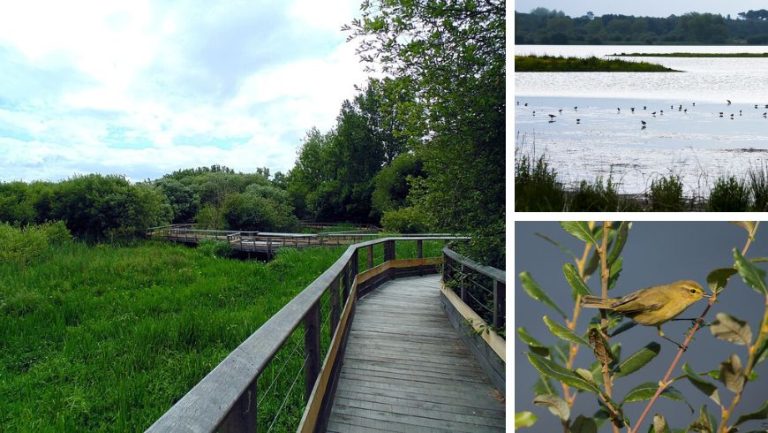
Just a few kilometres from the ocean, a surprisingly different landscape opens up: that of the Réserve Naturelle Nationale du Marais d’Orx, a large protected wetland that is one of the most interesting places in the region for observing wildlife and, above all, birds.
The reserve is home to rich biodiversity and is particularly well known for its populations of waterbirds. The area can be explored freely and free of charge along the trails open to the public, with wooden walkways and four observation points along the Marais Barrage circuit. Guided tours are also available for those who want to learn more about the ecosystem.
The most enjoyable way to get there is also by bicycle: a cycle path leads directly to the Maison Béziers, the entrance point to the reserve. Once there, however, bicycles must be left in the designated bicycle parking areas, as the reserve can only be visited on foot.
Important for those travelling with a dog: dogs are not allowed inside the nature reserve. This is an important detail for those who, like us, travel with a four-legged friend: in this case, it is best to plan the visit separately.
PARCC: contemporary art among the pine trees
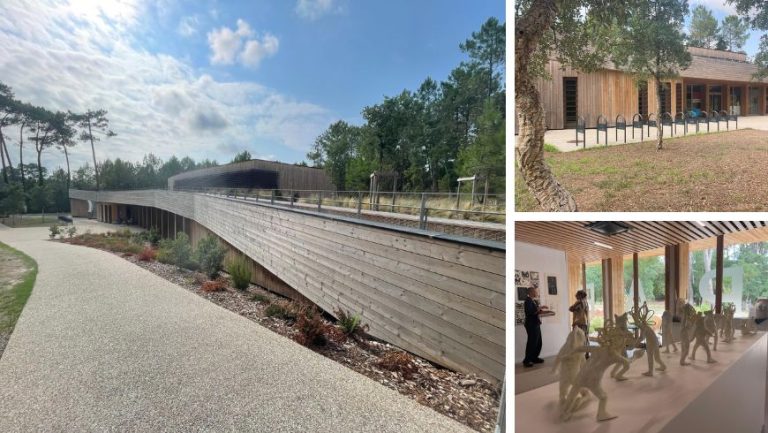
The second surprise in Labenne is completely different. In the heart of the town, surrounded by a small forest of pine and cork oak trees and next to a dune, lies the PARCC – Pôle Artistique Créatif Contemporain, a contemporary art centre that opened in June 2024. The project brings together contemporary art, landscape and reflection on the ecological transition.
The centre has around 300 square metres of exhibition space, three large rooms, a studio and spaces dedicated to educational activities and artistic workshops. The programme includes several temporary exhibitions throughout the year, as well as workshops and events for children and families.
Its location is perhaps the most curious feature: to reach the PARCC, you leave your car behind and follow a small path through the pine trees, creating a gradual transition from nature to art. And for those arriving from Ondres by bicycle, there is a lovely connection: the Vélodyssée makes it easy to reach the PARCC directly from Ondres, linking the two places through the cycle network.
It is an interesting example of how, even in a destination primarily known for the sea and surfing, you can find contemporary cultural experiences.
Tip: check the PARCC programme before setting off, as the exhibitions are temporary. The centre is currently open from Wednesday to Sunday, from 2 pm to 6 pm, with last admission at 5:30 pm.
This dual character makes Labenne an interesting stop even for those who do not want to spend every day on the beach: an hour among the birds and wetlands of Marais d’Orx, or an afternoon among contemporary art and pine trees at the PARCC. And, arriving by bicycle from Ondres, both experiences fit perfectly into the slow-travel spirit of our journey.
The flavours of South-West France: tips from an Ondres family
To truly get to know a place, you also have to eat like the people who live there. During our stay, we were lucky enough to do a home exchange with a family from Ondres. Before we arrived, they left us a small list of their favourite places: simple spots, markets and local specialities to try. These personal recommendations are often worth more than a guidebook.
In Ondres: bread, cheese and local markets
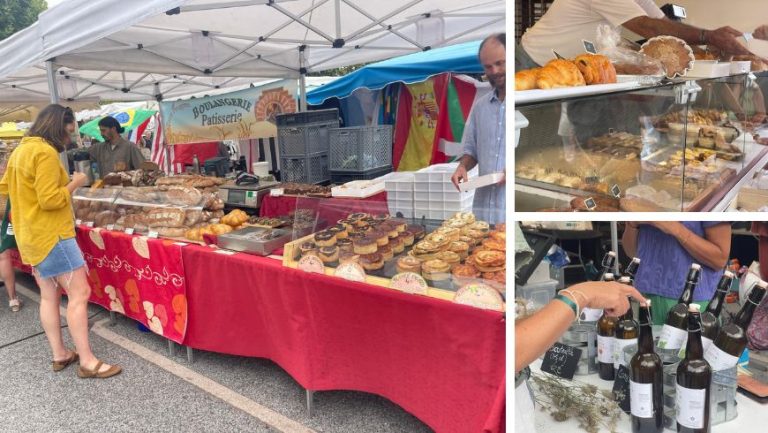
One event not to be missed is the Sunday morning market in Place Richard Feuillet: bread, pastries, cheese, cured meats, fruit and vegetables, local products and crafts fill the square from 8 am to 1 pm. For bread, they also recommended the bakery Le Fournil des Chaouches, on avenue du 11 Novembre 1918.
During the summer, the same area also hosts a night market on Tuesday evenings, with crafts, local specialities, jewellery and regional products.
In Bayonne: chocolate, Basque cuisine and coffee
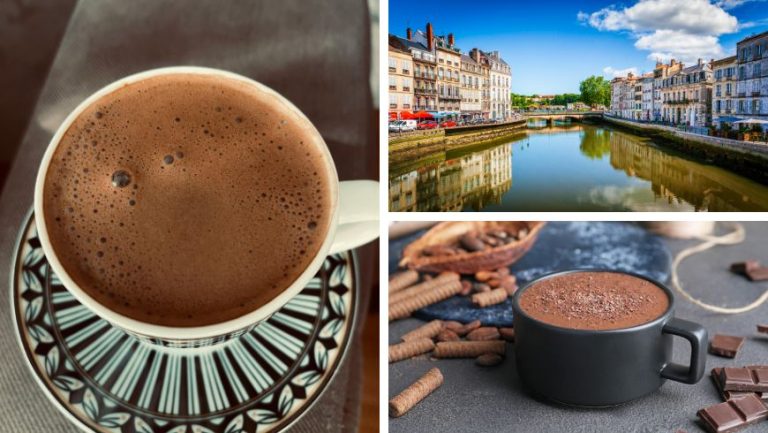
Crossing the Adour takes you into a different world. Bayonne is famous for its heritage, Basque culture and chocolate-making tradition. One address worth trying is Chocolat Cazenave, on Rue Port Neuf: its speciality is hot chocolate, served with brioche or toast and whipped cream.
If you want to buy chocolate to take home, the two recommended addresses are:
- Chocolat Daranatz, at 15 Rue Port Neuf, a historic Bayonne chocolate house founded in 1890, offering chocolate bars, bonbons, touron and other specialities.
- Monsieur Txokolat, on Rue Jacques Laffitte, another traditional address for Bayonne chocolate.
If you feel like trying a simple and tasty Basque dish, our host family recommended Café Moka, where you can also try Axoa, a traditional meat dish. The restaurant also stood out in recent reviews for its local cuisine and Axoa.
Finally, for a coffee break, they recommended Café Belza, in the historic centre of Bayonne.
From Seignanx to the French Basque Country, crossing the Adour
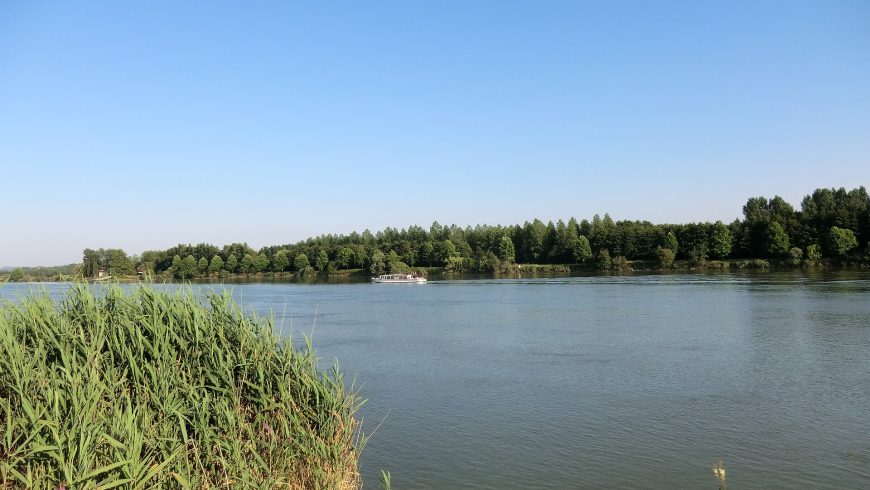
One of the things that struck us most about Seignanx is the possibility of experiencing very different landscapes from the same base.
From Ondres, you can cycle among pine trees and dunes, walk along the beach, surf and spend a day immersed in the natural landscapes of the Landes. Then, simply cross the Adour and you find yourself in a completely different setting.
Bayonne brings Basque architecture, language and traditions, markets and gastronomic culture. A little further on is Biarritz, with its history linked to the ocean, surfing, architecture and a decidedly more cosmopolitan atmosphere.
Further inland, meanwhile, lies the Vallée du Kiwi, with rivers, countryside, orchards and small rural towns: yet another landscape that shows just how varied this part of South-West France is.
After spending two weeks in Ondres, we realised that the true value of Seignanx lies precisely in its location and diversity. It is close enough to the ocean to enjoy the beach and dunes every day, surrounded by forest for cycling and walking among the pine trees, and at the same time close to the Adour, making it easy to reach Bayonne and the French Basque Country.
For those who travel slowly, it is a particularly interesting base: you can leave the car behind and get around by bicycle, follow the trails, reach the beach, stop at the market, buy local products and then set off for a day discovering a nearby yet completely different area.
For those looking for a more environmentally conscious holiday, Seignanx also offers plenty of sustainable-minded accommodation and campsites, ideal for exploring the area on foot or by bicycle and combining the sea, forest and nearby attractions.
That is Seignanx: a starting point between two worlds, where it is worth staying long enough to discover them both!
Cover image: Ondres beach, photo via Canva PRO