
Accessible signage in hospitality refers to room identification signs that incorporate tactile raised lettering, Braille, and high-contrast design to support guests with visual impairments or other navigation needs. In eco-friendly accommodations, these signs can also be specified with durable, low-impact materials that align with the property’s environmental approach.
When we talk about sustainable hospitality, the conversation usually centers on energy efficiency, locally sourced food, and waste reduction. These are essential pillars. But there is another dimension worth considering: whether a property works equally well for all guests, regardless of physical ability, age, or familiarity with the space. In this sense, accessibility can be considered an important part of the broader social dimension of sustainability: a truly sustainable accommodation should aim to be not only environmentally responsible, but also welcoming and usable by as many people as possible. In this sense, accessibility can be considered an important part of the broader social dimension of sustainability: a truly sustainable accommodation should aim to be not only environmentally responsible, but also welcoming and usable by as many people as possible.
Where Signage Connects to Sustainability
The connection between accessible signage and environmental sustainability is more direct than it might appear at first. It operates on two levels.
The first is material durability. A durable sign that remains in use for many years usually creates less replacement waste than one that degrades quickly and needs to be remanufactured. When choosing signage, durability can therefore be considered alongside other environmental factors, such as the material’s origin, recyclability, and overall life cycle. Three materials commonly used in interior signage align well with this principle:
- Wood — a renewable material that can offer long service life indoors when properly finished
- Stainless steel — highly durable and recyclable, with strong resistance to daily wear
- Acrylic — suitable for precise lettering and long-term interior use when specified correctly
The second level is social sustainability. A growing body of work from organizations such as UN Tourism and the European Network for Accessible Tourism (ENAT) frames accessibility as a component of responsible hospitality, not a separate compliance category. Properties that invest in clear, tactile signage are addressing a real barrier that some guests face when navigating unfamiliar spaces. And accessible design can benefit more people than those with a formally recognized disability: older guests, children, people unfamiliar with the language, or simply anyone navigating an unfamiliar building can all benefit from clear and intuitive signage.
What Accessible Signage Looks Like in Practice
For small-scale accommodations, the kind of properties that make up much of the Ecobnb community, implementing accessible signage does not require an industrial-scale project. A few targeted changes can make a meaningful difference.
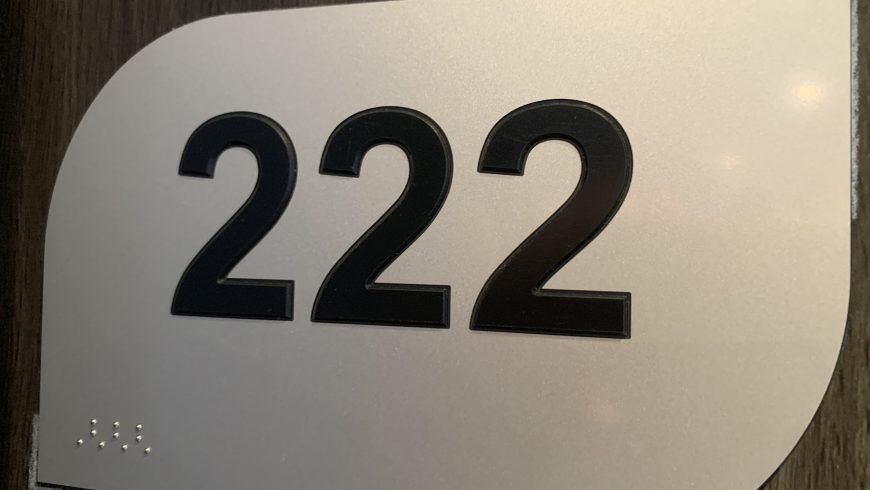
Room numbers on every guest room door, clearly labeled restroom facilities, and identification signs on shared spaces (kitchen, garden, common room) cover the essentials. Signs should have clear contrast between text and background, so they remain readable under varying lighting conditions. For properties that host guests with visual impairments, adding tactile raised letters and Braille to key signs can help transform the experience from one that requires staff assistance to one that supports independent navigation.
Mounting height and placement also matter. Signs placed at a consistent height, typically around 150 cm from the floor, are easier for all guests to locate. Requirements for tactile signage height, character size, and Braille grade vary by jurisdiction, so it is worth checking local accessibility standards before specifying.
For small eco-friendly accommodations, a few simple principles can provide a useful starting point:
- Use high contrast between text and background.
- Keep signage consistent, using the same visual language and positioning throughout the property.
- Add tactile lettering and Braille to key signs where appropriate.
- Clearly identify essential spaces, including guest rooms, bathrooms and common areas.
- Avoid overly decorative fonts or complex layouts that may reduce readability.
- Consider accessibility from the beginning of a renovation or fit-out, rather than treating it as an addition at the end of the project.
For eco-friendly properties where ADA signage or equivalent accessible room identification is part of the fit-out, choosing durable materials and permanent mounting methods means the signs can perform reliably for years while reducing the need for replacement. When working outside the United States, however, properties should refer to the accessibility standards and regulations applicable in their own country.

A Broader View
Accessibility and environmental sustainability share a practical overlap: both benefit from long-term thinking, durable materials, and design decisions made with the widest possible range of users in mind. An eco-lodge that specifies room signs in materials built to last, with tactile elements integrated from the start, is making a single investment that serves both goals.
This is part of a broader principle of sustainable hospitality: designing spaces that respect both the planet and the people who use them. Energy-efficient systems, local food and waste reduction remain essential, but sustainability can also be reflected in the way a guest moves through, understands and experiences a place.
An ecological approach to hospitality does not stop at energy systems and food sourcing. It also extends to whether the space itself is navigable, welcoming, and usable for different guests, including those with visual or mobility impairments. The signage on the doors is a practical place to start.
Cover image: photo by Jason Briscoe via Unsplash